
- Why Decluttering Is Becoming More Important in Metro Cities
- Start With One Simple Question: “How Often Do I Use This?”
- What Should You Do With Wedding Clothes?
- What About Wedding Decorations?
- Seasonal Clothes: Stop Letting Winter Occupy Your Whole Wardrobe
- But What If Your Apartment Simply Doesn't Have Enough Storage?
- The “Keep, Store, Sell, Donate” Method
- When Does Professional Storage Make Sense?
- Don't Turn Your Spare Bedroom Into a Warehouse
- What About Old Furniture?
- A Better Storage System for Indian Families
- Store What Matters With Xtended Space
- Final Thought
- Frequently Asked Questions
If you live in a metro city, you probably know this feeling.
Your wardrobe is full.
The bed has storage underneath—but it’s full too.
The kitchen cabinets are overflowing.
There’s a suitcase sitting behind the sofa that you haven’t opened in eight months.
And somewhere in the house is an entire collection of wedding clothes, decorations and belongings that you may use once or twice a year.
Yet every time you try to declutter, you face the same question:
“I don’t use this every day, but I don’t want to throw it away either.”
That’s the real challenge of living in modern Indian apartments.
The problem isn’t always that you own too much.
It’s that your home doesn’t have enough space for things you don’t need every day but still want to keep.
Seasonal clothes, winter blankets, wedding outfits, festive decorations, suitcases, extra mattresses, childhood memories and occasional furniture can quickly turn a comfortable 2BHK or 3BHK into a storage room.
The good news?
You don’t have to throw everything away.
You simply need a better system for deciding what stays, what goes and what gets stored elsewhere.
Why Decluttering Is Becoming More Important in Metro Cities
Homes in cities such as Delhi NCR, Mumbai, Bengaluru, Hyderabad, Pune and Chennai often come with a trade-off.
You get better connectivity, amenities and access to work—but living space can be limited and expensive.
That makes every square foot valuable.
A spare bedroom becomes a home office.
The balcony becomes a laundry area.
The storage room becomes a dumping ground.
And your wardrobe somehow becomes responsible for housing clothes from four different seasons.
This is why small apartment storage ideas are no longer just an interior-design problem.
They’re a lifestyle problem.
Start With One Simple Question: “How Often Do I Use This?”
Before throwing anything away, divide your belongings into four categories.
1. Use Every Day
These stay at home.
Clothes you regularly wear, daily kitchen items, frequently used electronics and everyday essentials don’t need complicated storage.
2. Use Occasionally
These might include suitcases, winter jackets, festive cookware and certain appliances.
Keep them at home if you have sufficient space, but organize them properly.
3. Seasonal or Annual
This is where the clutter usually starts.
Think:
- Winter blankets
- Heavy jackets
- Wedding outfits
- Diwali decorations
- Christmas decorations
- Festive lights
- Large serving sets
- Seasonal sports equipment
- Extra bedding
You need these items—but not every week.
4. “I Might Need This Someday”
This category deserves the most attention.
If you’ve moved it from one apartment to another for five years without using it, ask yourself whether you’re storing an object—or simply storing a memory.
Some things should be donated or sold.
Others genuinely deserve to be kept.
The trick is knowing the difference.
What Should You Do With Wedding Clothes?
Indian weddings create a unique storage problem.
A single wedding can generate:
Lehengas. Sarees. Sherwanis. Suits. Dupattas. Jewellery boxes. Wedding shoes. Gift packaging. Décor. Invitation cards. Return gifts.
And then there are clothes belonging to parents and relatives that are brought out only for special occasions.
Throwing them away isn’t realistic.
But keeping every wedding outfit in your everyday wardrobe isn’t practical either.
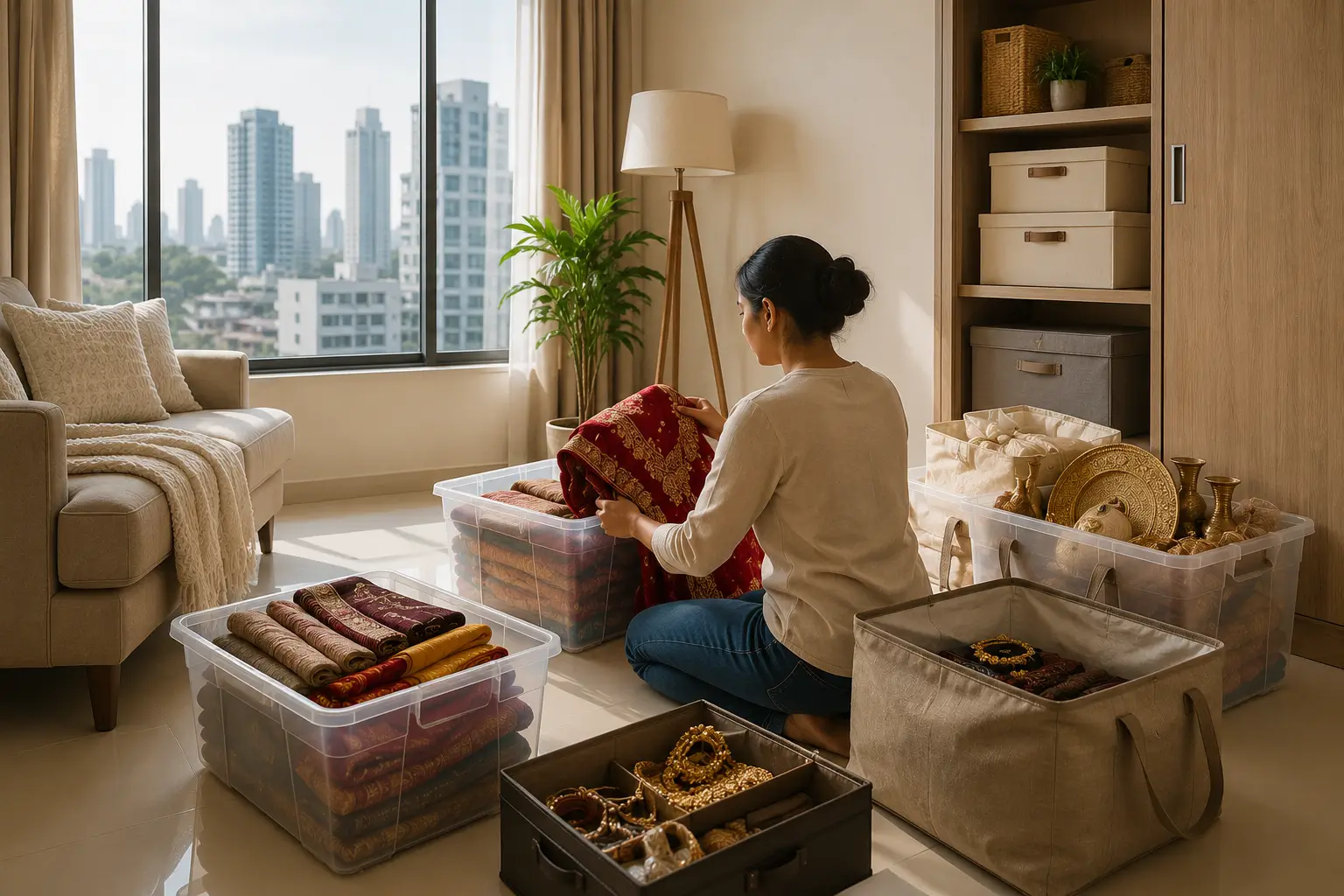
Create a “Wedding & Occasion” category.
Keep these items together instead of scattering them throughout the house.
Use appropriate garment storage, protect delicate fabrics from moisture and pests, and avoid overcrowding wardrobes.
For extremely valuable or delicate outfits, consider professional cleaning and appropriate packaging before long-term storage.
The goal is simple:
Protect the outfit without allowing it to occupy prime everyday wardrobe space.
Explore your local thrift stores or online marketplaces for hidden gems. You’ll be surprised at the unique and affordable items you can find. From vintage lamps to quirky wall art, thrift shopping is a budget-friendly way to add character to your home.
What About Wedding Decorations?
This is where many Indian homes lose a surprising amount of space.
A wedding may leave you with:
- Artificial flowers
- Decorative lights
- Backdrops
- Gift baskets
- Serving items
- Fabric decorations
- Decorative stands
- Photo props
- Boxes of miscellaneous wedding supplies
Most of these items may be used again.
But they don’t need to live in your living room for the next 11 months.
If you’re confident you’ll reuse them, pack them into clearly labelled containers.
If you haven’t used them after several years, consider donating them or passing them to someone who will.
And if they’re valuable but rarely needed, off-site storage can be an excellent middle ground.
Seasonal Clothes: Stop Letting Winter Occupy Your Whole Wardrobe
If you live in a city with distinct seasons, your wardrobe can effectively double in size.
Summer clothes.
Winter clothes.
Rainwear.
Blankets.
Jackets.
Thermals.
Heavy ethnic wear.
You don’t need all of them accessible at the same time.
A simple seasonal rotation can immediately free up space.
At the end of winter, wash and completely dry winter clothes and blankets before packing them away. Use suitable storage bags or containers and label everything clearly.
Then rotate.
Winter goes out. Summer comes in.
Your wardrobe becomes easier to use without buying another cupboard.
But What If Your Apartment Simply Doesn't Have Enough Storage?
This is where many homeowners reach the same conclusion:
“I’ve already decluttered. I still don’t have enough space.”
That’s when you need to think beyond cupboards.
Professional household storage can be useful for belongings that are:
- Valuable
- Used occasionally
- Seasonal
- Difficult to replace
- Too large for your apartment
- Not currently needed
Instead of filling your home with things you use twice a year, move selected belongings into dedicated storage.
This doesn’t mean you’re becoming a hoarder.
Quite the opposite.
You’re separating your living space from your long-term belongings.
The “Keep, Store, Sell, Donate” Method
Here’s a simple system you can use this weekend.
Take one room or cupboard at a time.
Then create four piles.
KEEP
Things you use regularly.
STORE
Things you want but use occasionally.
Examples include wedding clothes, seasonal items, festive decorations and extra furniture.
SELL
Items that still have value but you no longer need.
DONATE
Items that are useful but aren’t worth the effort of selling.
This prevents the common decluttering mistake of putting everything back into the cupboard because you don’t know what else to do with it.
When Does Professional Storage Make Sense?
You don’t need external storage for every item.
It makes the most sense when your belongings are:
Seasonal: You use them for only a few weeks each year.
Sentimental: You don’t want to throw them away.
Bulky: They occupy valuable apartment space.
Occasional: You need them once or twice a year.
Between homes: You’re relocating or renovating.
Family belongings: You’re temporarily storing possessions for parents or children.
For example, Xtended Space provides storage solutions for furniture and household belongings, including pickup and delivery and secure monitored storage. Its furniture-storage service can accommodate items such as sofas, beds, mattresses, dining tables and office furniture. This can be particularly useful if your apartment is already operating at its maximum storage capacity.
Don't Turn Your Spare Bedroom Into a Warehouse
This is a trap many apartment owners fall into.
You have a spare bedroom.
So you put a few boxes there.
Then a suitcase.
Then winter blankets.
Then wedding decorations.
Then an old mattress.
Six months later, the room isn’t a bedroom anymore.
It’s a warehouse.
And you’ve effectively lost an entire room of your apartment.
External storage can change that equation.
Instead of sacrificing an entire room to belongings you rarely use, you can keep your home focused on the things you actually use.
What About Old Furniture?
Furniture is another major source of apartment clutter.
Maybe you’re upgrading your sofa.
Maybe your child has moved out.
Maybe you’re renovating.
Maybe you simply bought a new dining table.
But the old furniture is still perfectly usable.
You have three options:
Sell it if you no longer need it.
Donate it if someone else can use it.
Store it if you genuinely expect to need it later.
The worst option?
Moving it from room to room indefinitely.
A Better Storage System for Indian Families
One of the biggest mistakes people make is storing everything without labelling it.
Six months later:
“Where did we keep the wedding decorations?”
Nobody knows.
Use transparent containers where appropriate and label boxes clearly.
For example:
BOX 01 — WINTER CLOTHES
BOX 02 — DIWALI DECORATIONS
BOX 03 — WEDDING OUTFITS — FAMILY
BOX 04 — FESTIVE SERVING ITEMS
If you’re using professional storage, maintain a digital inventory as well.
Xtended Space uses barcode-based inventory tracking for stored items, making it easier to keep track of belongings.
The 30-Minute Metro Apartment Decluttering Challenge
Don’t try to declutter your entire home in one day.
Start with 30 minutes.
First 10 minutes:
Choose one cupboard, drawer or storage area.
Next 10 minutes:
Separate items into Keep, Store, Sell and Donate.
Final 10 minutes:
Pack and label everything that isn’t staying in that space.
Repeat this once a week.
After a month, you’ll be surprised how much space you’ve recovered.
Your Home Should Store Your Life—Not Your Clutter
There’s nothing wrong with keeping your wedding lehenga.
There’s nothing wrong with saving your grandmother’s furniture.
There’s nothing wrong with keeping Diwali decorations that you genuinely love.
The problem begins when things you rarely use start controlling how you live every day.
Your home should be designed around your life—not around finding space for everything you’ve ever owned.
And sometimes, the smartest storage solution isn’t another cupboard.
It’s moving occasional belongings out of your living space entirely.
Store What Matters With Xtended Space
If you’ve decluttered your apartment but still have belongings you genuinely want to keep, Xtended Space can help.
From furniture and mattresses to seasonal belongings and household items, professional storage can give you the extra space your apartment doesn’t have—without forcing you to throw away things you may need later.
Whether you’re preparing for a wedding, switching seasons, renovating your home or simply trying to reclaim your spare bedroom, the idea is simple:
Keep what matters. Store what you don’t need today. Let your home breathe.
Ready to reclaim your apartment?
Get a storage quote from Xtended Space and turn unused belongings into usable space.
Final Thought
Decluttering doesn’t mean getting rid of everything you love.
Sometimes, it simply means putting the right things in the right place.
Your wedding clothes don’t need to occupy half your wardrobe.
Your Diwali decorations don’t need to live under your bed for 12 months.
And your old sofa doesn’t need to turn your spare bedroom into a warehouse.
Keep the memories. Lose the clutter.
Xtended Space — More room for what matters.
Frequently Asked Questions
1. How do I declutter a small apartment?
Start room by room and divide belongings into four categories: Keep, Store, Sell and Donate. Avoid trying to declutter the entire apartment at once.
2. Where should I store wedding clothes?
Store wedding clothes separately from everyday clothing. Clean and dry garments thoroughly before long-term storage and use appropriate garment protection.
3. How do I store wedding decorations?
Sort decorations by type, use labelled containers and protect delicate items from moisture and dust. If you use them only once a year, professional storage can free up valuable apartment space.
4. What should I do with seasonal clothes?
Wash and completely dry seasonal clothing before packing it away. Use appropriate storage bags or containers and label them so they’re easy to locate when the season changes.
5. Is self storage good for small apartments?
Yes. External storage can be particularly useful when an apartment has limited storage space but you still need to keep seasonal, sentimental or occasional belongings.
6. Should I sell or store old furniture?
If you genuinely expect to use the furniture again, storage can make sense. If you haven’t used it for years and have no realistic future need for it, selling or donating may be better.
7. How can I create more storage space without renovating?
Decluttering, seasonal rotation, vertical storage, labelled containers and professional off-site storage can create more usable space without changing your apartment’s layout.
8. Is professional household storage safe?
Safety depends on the provider. Look for facilities offering security measures such as CCTV, restricted access, inventory tracking and appropriate protection/insurance terms.
9. Can I store furniture and household items together?
Depending on the storage provider, yes. Check what categories of belongings are accepted and how they are packed, inventoried and stored.
10. How do I find storage space near me?
Search for household or self-storage providers in your city and compare pricing, security, pickup and delivery, insurance and storage terms before choosing a provider.