
- What Is Micro-Warehousing?
- Why Full Warehouses Can Become a Margin Problem
- The Hidden Cost of “Having Your Own Warehouse”
- Micro-Warehousing Turns Fixed Costs Into Variable Costs
- Micro-Warehousing Is Especially Useful for D2C Brands
- Don't Confuse Storage With Fulfilment
- Location Matters More Than Most Founders Think
- Micro-Warehousing Can Help With Faster Delivery
- What About Returns?
- When Should a D2C Brand Consider Micro-Warehousing?
- Micro-Warehouse vs Traditional Warehouse
- What Should You Look for in a Micro-Warehouse?
- Why Micro-Warehousing Can Be a Better Financial Strategy
- Micro-Warehousing With Xtended Space
- Final Thought
- Frequently Asked Questions
Starting a D2C brand in India has never been easier.
You can launch a skincare brand from your bedroom, build a Shopify store in a weekend, run Meta and Google campaigns, partner with marketplaces and start receiving orders from customers across the country.
But then comes a problem that doesn’t look serious on Day 1.
Inventory.
At first, you have 100 products.
Then 500.
Then 2,000.
Suddenly, your spare bedroom is full of cartons.
Your office has become a packing station.
Your team is walking around boxes.
And someone says:
“We need a warehouse.”
It sounds like the logical next step.
But here’s the problem:
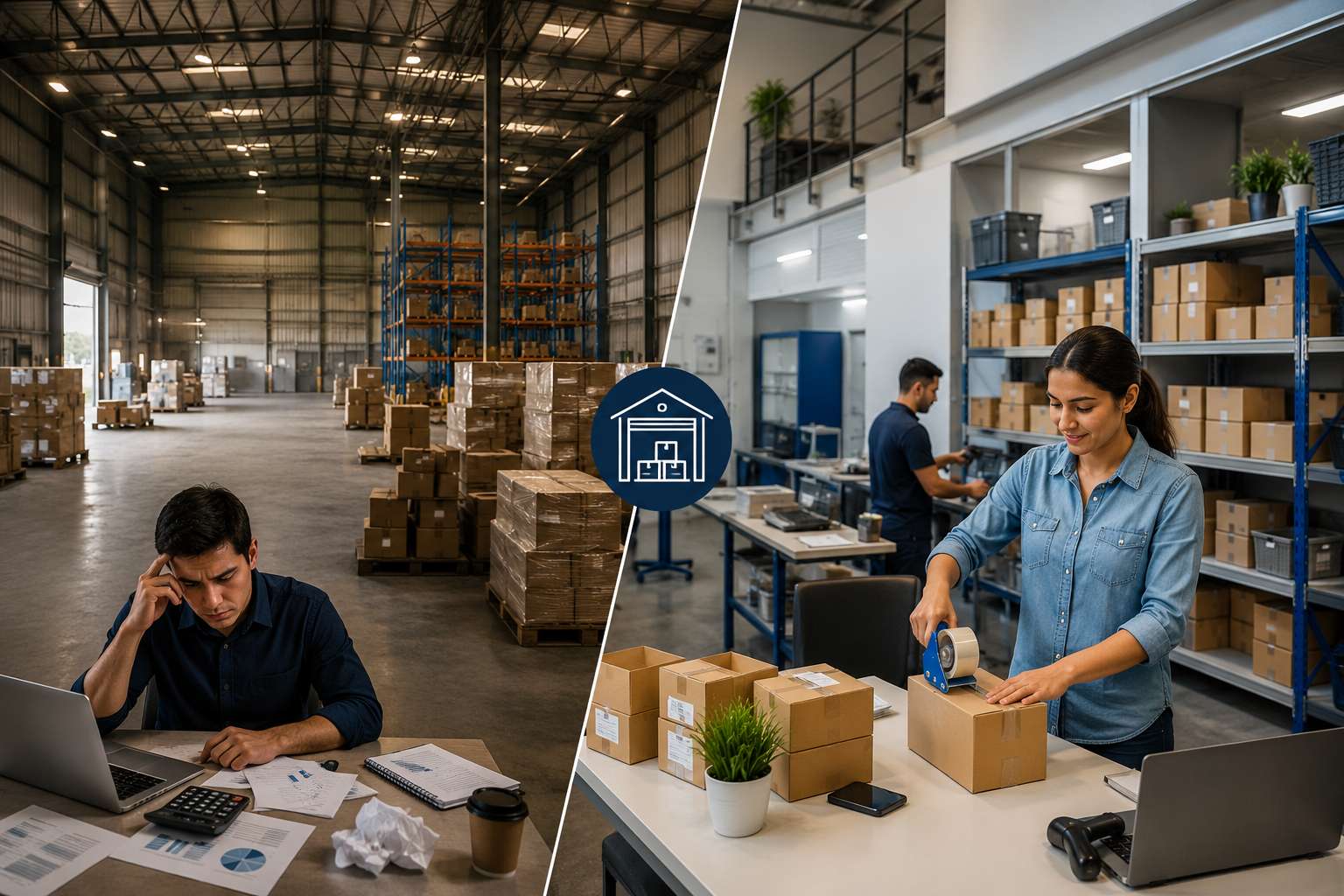
A full warehouse can become one of the most expensive mistakes a growing D2C brand makes too early.
You don’t just pay rent.
You pay for unused space, electricity, security, labour, racks, handling, technology, maintenance and logistics.
And if your inventory isn’t moving quickly enough, you’re essentially paying to store your own cash.
This is where micro-warehousing can change the equation.
What Is Micro-Warehousing?
Micro-warehousing means using smaller, strategically located storage spaces instead of immediately committing to a large traditional warehouse.
The concept is simple:
Store only the inventory you actually need, where you actually need it.
For a growing D2C brand, this could mean storing a few hundred boxes, several pallets or selected SKUs in a professionally managed facility rather than renting an entire warehouse.
Depending on the provider, micro-warehousing can also be combined with:
- Inventory management
- Packing
- Order fulfilment
- Pickup and delivery
- Last-mile logistics
- Barcode tracking
- Returns handling
The important difference is that you’re buying usable capacity, rather than simply renting empty square footage.
Why Full Warehouses Can Become a Margin Problem
Let’s take a hypothetical D2C brand.
Suppose your business generates ₹25 lakh in monthly revenue.
Sounds impressive.
But imagine your gross margin is 45%.
That’s ₹11.25 lakh before several operating expenses.
Now add:
- Warehouse rent
- Salaries
- Packaging
- Electricity
- Security
- Inventory handling
- Software
- Transportation
- Returns
- Marketing
Suddenly, the warehouse isn’t just a place where your products sit.
It’s affecting your contribution margin.
And the biggest issue is often underutilisation.
Imagine renting 5,000 sq. ft. but using only 1,800 sq. ft.
You’re not just paying for 1,800 sq. ft.
You’re paying for 5,000.
That’s where micro-warehousing becomes interesting.
The Hidden Cost of “Having Your Own Warehouse”
When entrepreneurs calculate warehouse costs, they often calculate only rent.
That’s rarely the full picture.
1. Rent
The obvious expense.
2. Deposit
Commercial leases can require significant upfront capital.
3. Racking
Your products need organised storage.
4. Staff
Someone has to receive, count, pick, pack and dispatch orders.
5. Utilities
Electricity, internet, equipment and maintenance add up.
6. Security
Inventory is an asset.
It needs protection.
7. Warehouse Management Software
As SKU counts increase, spreadsheets stop being enough.
8. Material Handling
Trolleys, pallets, packaging equipment and other infrastructure aren’t free.
9. Idle Capacity
This is perhaps the biggest hidden cost.
You pay for space even when you don’t use it.
Micro-Warehousing Turns Fixed Costs Into Variable Costs
This is one of the biggest financial advantages.
A traditional warehouse often creates fixed costs.
You pay the rent whether you receive:
100 orders or 10,000 orders.
Micro-warehousing and third-party storage can allow businesses to scale storage according to their inventory requirements.
That’s particularly useful for young D2C brands because demand isn’t always predictable.
One month, your skincare product goes viral.
The next month, sales normalise.
One product becomes a bestseller.
Another gets discontinued.
Your storage requirement changes.
Your warehouse shouldn’t become a financial burden every time your sales forecast changes.
Micro-Warehousing Is Especially Useful for D2C Brands
D2C brands often have a very different inventory profile from traditional manufacturers.
They may have:
- Multiple SKUs
- Small product batches
- Frequent product launches
- Seasonal demand
- Influencer-driven spikes
- Flash sales
- Festival campaigns
- High-return categories
- Marketplace orders
- Website orders
Imagine a beauty brand launching a new serum.
The brand expects 5,000 units to sell over six months.
Instead, a creator’s Instagram Reel goes viral.
The brand sells 5,000 units in three weeks.
Suddenly, the problem isn’t warehouse capacity.
It’s fulfilment speed.
This is why strategically located storage can become valuable.
Don't Confuse Storage With Fulfilment
This distinction is important.
A warehouse primarily stores inventory.
A fulfilment centre can do much more.
It may receive inventory, store it, pick products after orders are received, pack them and hand them over to logistics partners.
For D2C brands, this can eliminate several operational headaches.
Instead of:
Manufacturer → Your warehouse → Your team → Courier
you can potentially create:
Manufacturer → Fulfilment facility → Customer
That’s fewer moving parts.
And fewer moving parts can mean fewer opportunities for mistakes.
Location Matters More Than Most Founders Think
A warehouse doesn’t have to be beside your office.
It needs to be strategically positioned for your customers and supply chain.
For example, if most of your customers are in Delhi NCR, storing inventory in a facility near a major NCR logistics corridor can potentially reduce delivery complexity.
Similarly, brands serving Bengaluru, Mumbai or Hyderabad may benefit from strategically positioned inventory.
This is one reason micro-warehousing can be useful for brands that are expanding geographically.
Instead of immediately taking one giant warehouse, a brand can consider smaller storage nodes closer to major customer markets.
Micro-Warehousing Can Help With Faster Delivery
Customers have become impatient.
That’s not necessarily a bad thing.
It means the standard for ecommerce has changed.
When customers are used to quick delivery from large marketplaces, a small D2C brand offering five-to-seven-day delivery can struggle to compete.
Strategic inventory placement can help.
Suppose 40% of your orders come from Bengaluru.
Keeping inventory closer to Bengaluru may reduce the distance that orders need to travel.
The same principle can be applied to other major markets.
The goal isn’t simply:
“Store cheaply.”
The goal is:
“Store intelligently.”
What About Returns?
Here’s another area where D2C brands can lose money.
A customer orders a product.
It gets delivered.
The customer returns it.
Now someone needs to:
- Receive the returned item
- Inspect it
- Update inventory
- Repackage it
- Decide whether it’s sellable
- Put it back into stock
If your team is doing this manually, returns can become expensive.
A professional warehousing or fulfilment partner may be able to support parts of this process, depending on its service model.
That lets founders focus on what actually grows the brand:
Product. Marketing. Customers.
Not counting boxes at 11 PM.
When Should a D2C Brand Consider Micro-Warehousing?
There isn’t one magic revenue number.
Instead, look at your operational signals.
Consider it when:
Your home or office is overflowing with inventory.
Your team spends too much time packing orders.
Warehouse rent is becoming a meaningful fixed expense.
You have unpredictable inventory requirements.
You are expanding into new cities.
You have multiple sales channels.
Your SKU count is increasing.
You are struggling with inventory accuracy.
Your returns process is becoming difficult.
You need faster fulfilment.
These are stronger signals than simply saying:
“We’ve crossed ₹1 crore revenue, so we need a warehouse.”
Micro-Warehouse vs Traditional Warehouse
Factor | Micro-Warehousing | Full Warehouse |
Initial commitment | Lower | Higher |
Flexibility | High | Lower |
Fixed overhead | Generally lower | Higher |
Scalability | Easier | Requires expansion |
Ideal for | Growing D2C brands | Large established operations |
Space utilisation | Usually focused | Can be underutilised |
Operations | Often outsourced | Usually managed internally |
Capital requirement | Lower | Higher |
Neither model is universally better.
A large established brand with predictable volumes may benefit from its own warehouse.
But for an early-stage or rapidly changing D2C business, flexibility can be more valuable than square footage.
What Should You Look for in a Micro-Warehouse?
Don’t choose based purely on the lowest price.
Look at the entire operating model.
Security
Check CCTV, access control and security procedures.
Inventory Management
Barcode or digital inventory tracking can reduce errors.
Location
Look at proximity to suppliers, customers and logistics hubs.
Pickup & Delivery
Can inventory be collected from your manufacturer?
Scalability
Can you increase storage when your business grows?
Minimum Commitment
Understand minimum booking periods and contractual terms.
Fulfilment
If you need pick-and-pack services, confirm whether they’re available.
Insurance
Understand what protection applies to your inventory.
Pricing Transparency
Ask about storage, handling, loading, unloading, packing and transportation charges separately.
Why Micro-Warehousing Can Be a Better Financial Strategy
Here’s the bigger business lesson.
A warehouse should support your growth—not become a cost centre that your growth has to support.
If you’re spending heavily on storage before your inventory turns quickly enough, you’re tying up capital.
That capital could instead go towards:
- Marketing
- Product development
- Customer acquisition
- Better packaging
- New SKUs
- Hiring
- Technology
For a D2C founder, that difference matters.
Because the best warehouse isn’t necessarily the biggest one.
It’s the one that matches your current business.
Micro-Warehousing With Xtended Space
For D2C brands that don’t want to commit to a traditional warehouse immediately, Xtended Space offers warehouse-storage solutions designed around different inventory requirements.
The service provides warehouse storage options ranging from smaller inventories to larger household and business requirements, with advertised pricing starting from ₹5 per sq. ft., depending on the storage requirement and terms. Xtended Space also offers logistics and inventory-related services.
For businesses, this can create a more flexible alternative to signing a large warehouse lease before the business actually needs one.
Growing inventory but not ready for a full warehouse?
Store smarter. Scale faster.
👉 Talk to Xtended Space about warehouse and micro-storage requirements for your D2C brand.
Final Thought
The D2C game is about speed, margins and flexibility.
Don’t let your warehouse become the opposite of all three.
You don’t need a massive warehouse just because your brand is growing.
You need the right amount of space at the right time, in the right location, at the right cost.
Start lean.
Store intelligently.
Scale when the numbers justify it.
Because the goal isn’t to own more warehouse space.
The goal is to build a more profitable brand.
Xtended Space — More room for your business to grow.
Frequently Asked Questions
1. What is micro-warehousing?
Micro-warehousing involves using smaller, strategically located storage facilities instead of committing to a large traditional warehouse.
2. Is micro-warehousing good for D2C brands?
Yes. It can be particularly useful for growing D2C brands with changing inventory levels, multiple SKUs and unpredictable demand.
3. Is micro-warehousing cheaper than renting a warehouse?
It can reduce fixed overhead and capital requirements, but the actual cost depends on inventory volume, location, duration, fulfilment and logistics services.
4. Can I store ecommerce inventory in a micro-warehouse?
Yes, subject to the facility’s policies. Many business storage providers support inventory storage for ecommerce and D2C brands.
5. Can a warehouse also fulfil D2C orders?
Some providers offer fulfilment services such as picking, packing and dispatch in addition to storage. Confirm the exact services before signing up.
6. What is the difference between a warehouse and a fulfilment centre?
A warehouse primarily stores inventory. A fulfilment centre typically handles additional activities such as receiving, picking, packing and dispatching customer orders.
7. How much warehouse space does a D2C brand need?
It depends on SKU count, inventory volume, product dimensions, order frequency and stock-turnover rate. Avoid renting significantly more space than your current inventory requires.
8. Should a startup rent its own warehouse?
Not necessarily. Startups should compare the total cost of rent, staff, equipment, utilities and management against third-party or flexible storage options.
9. Can D2C brands scale storage as they grow?
Flexible warehousing providers may allow businesses to increase storage capacity as inventory grows. Always check the provider’s expansion terms.
10. How do I choose a warehouse for my ecommerce business?
Compare location, security, storage capacity, inventory tracking, fulfilment capability, transportation, pricing, minimum commitment and scalability.