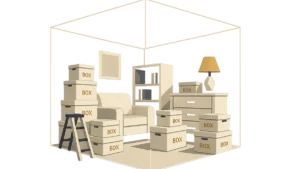


- The Hidden Cost of Moving Between Metro Cities
- Why Relocation Creates a Storage Problem
- The “Empty Flat” Trap
- What If Your New Home Is Smaller?
- Furniture Storage vs Paying Rent: What Makes More Sense?
- What Should You Put Into Storage During Relocation?
- What About Moving Furniture to Family's House?
- Why Professional Storage Can Be Better Than DIY Storage
- The Biggest Benefit? You Buy Yourself Time
- Relocating From a Metro City? Storage Can Help You Downsize
- A Simple Relocation Storage Checklist
- Don't Pay ₹30,000–₹50,000 a Month Just to Store Your Sofa
- Store Your Furniture. Keep Your Options Open.
- Final Thought
- Frequently Asked Questions
Moving to another city sounds exciting when you imagine the new beginning.
A better job. A new apartment. A different neighbourhood. Maybe even a completely different lifestyle.
But anyone who has actually relocated from Delhi to Bengaluru, Mumbai to Hyderabad, Pune to Gurgaon or Noida to another metro city knows there is one less glamorous part of moving:
What do you do with all your furniture?
Your new apartment may not be ready.
Your lease may have already ended.
Your family may be staying somewhere temporarily.
Your new job may require you to move before your permanent home is available.
And suddenly, you find yourself paying rent for an empty flat simply because your furniture is still sitting inside it.
That is where the economics of relocation start getting interesting.
Because sometimes, paying rent to store your belongings in an apartment is more expensive—and far less convenient—than using dedicated storage.
The Hidden Cost of Moving Between Metro Cities
Let’s imagine a fairly common situation.
You are moving from Gurgaon to Bengaluru.
Your existing apartment costs ₹35,000 per month.
Your new accommodation won’t be ready for another two months.
You have two choices.
Option A: Keep the old apartment
You continue paying:
₹35,000 × 2 months = ₹70,000
And that’s before electricity, maintenance, internet, cleaning and other expenses.
You’re effectively paying ₹70,000 simply to keep your furniture somewhere.
Option B: Move the furniture into storage
You move your furniture into a dedicated storage facility and stop paying rent on the old apartment.
Now your housing decision and your furniture-storage decision become two separate things.
That’s an important distinction.
You shouldn’t have to keep an entire apartment just because you don’t yet know where your sofa is going.
Why Relocation Creates a Storage Problem
Relocation rarely happens perfectly.
Sometimes your new home is delayed.
Sometimes your employer gives you a joining date before your accommodation is ready.
Sometimes you move into a smaller apartment and discover that your old three-bedroom home’s furniture simply doesn’t fit.
And sometimes you move temporarily before deciding where you actually want to live.
This is particularly common among professionals relocating between India’s major employment hubs.
You might spend a few weeks in a serviced apartment, hotel or rented room while looking for a permanent home.
But your furniture?
It still needs somewhere to go.
That’s where temporary furniture storage during relocation can make the transition considerably easier.
The “Empty Flat” Trap
One of the biggest mistakes people make during relocation is thinking:
“I’ll just keep the flat for another month or two.”
One month becomes two.
Two becomes three.
Meanwhile, you’re paying rent for an apartment you’re barely using.
And there’s another problem.
An empty apartment isn’t necessarily free storage.
You still have to deal with:
- Electricity bills
- Maintenance charges
- Cleaning
- Pest control
- Security
- Landlord coordination
- Society restrictions
- Potential damage
- Moving furniture again later
The apartment is becoming an expensive warehouse.
Except you’re paying residential rent for it.
What If Your New Home Is Smaller?
This is another increasingly common relocation problem.
Imagine you move from a 3BHK in Gurgaon to a 2BHK in Bengaluru.
Suddenly, the furniture that comfortably fit into your old home doesn’t fit into the new one.
Do you throw away a perfectly good sofa?
Sell a dining table you’ve owned for years?
Give away your bed because there isn’t enough space?
Not necessarily.
You could store the pieces you don’t immediately need and decide later.
This gives you something that is surprisingly valuable during relocation:
time.
Instead of making permanent decisions under moving-day pressure, you can live in the new home for a few weeks and understand what actually fits.
Furniture Storage vs Paying Rent: What Makes More Sense?
Let’s simplify the decision.
Situation | Keeping Old Flat | Storage |
New home delayed | Expensive | Flexible |
Moving temporarily | Often unnecessary | Convenient |
Downsizing | Wastes space | Useful |
Job transfer | Difficult | Practical |
Unsure about new home | Locks you into rent | Gives flexibility |
Need furniture later | Already there | Can retrieve when required |
The biggest advantage isn’t necessarily that storage is always cheaper.
It is that storage separates your housing decision from your furniture decision.
And that flexibility can be extremely valuable.
What Should You Put Into Storage During Relocation?
You don’t necessarily need to store everything.
A smart relocation inventory usually has three categories.
1. Take With You
Keep everyday essentials with you:
- Clothes
- Documents
- Electronics
- Daily-use kitchen items
- Personal belongings
2. Store
Consider storing items you still want but don’t immediately need:
- Sofa
- Beds
- Dining table
- Mattresses
- Wardrobes
- Office furniture
- Extra chairs
- Seasonal items
- Large appliances
- Household belongings
3. Sell or Donate
Finally, be honest about things you haven’t used for years.
Relocation is actually an excellent opportunity to declutter.
The objective isn’t to store everything.
It’s to store the things that are worth keeping.
What About Moving Furniture to Family's House?
This sounds like a free solution.
Until you consider the logistics.
Your parents’ garage is already full.
Your relatives live 40 kilometres away.
Your furniture needs to be moved twice.
And six months later, you need another truck to bring everything back.
What looked free suddenly becomes a logistical project.
Professional storage can eliminate some of that unnecessary movement.
With a dedicated facility, your belongings remain in one place until you’re ready for them.
Why Professional Storage Can Be Better Than DIY Storage
A common question is:
“Why can’t I just keep everything in my garage?”
You can—if you have a suitable garage.
But many homes don’t.
And even when they do, garages and spare rooms aren’t necessarily designed for long-term furniture storage.
Professional storage services can offer dedicated space, controlled access and security measures.
For example, Xtended Space provides household and furniture storage for people relocating, renovating or temporarily moving cities. Its furniture-storage service includes pickup and delivery, 24/7 CCTV surveillance, restricted access, barcode-based inventory tracking and insurance coverage.
That means you don’t have to turn your temporary accommodation into a warehouse.
The Biggest Benefit? You Buy Yourself Time
This is the part of relocation that people underestimate.
When you’re moving cities, everything feels urgent.
You have to find a home.
Start a new job.
Understand a new commute.
Set up utilities.
Meet new people.
Figure out schools if you’re moving with children.
The last thing you need is:
“Where am I going to put my old dining table?”
Storage gives you breathing room.
You can move first.
Settle down.
Understand the new city.
Then decide what you actually need.
Maybe your new apartment has enough space for everything.
Maybe it doesn’t.
Maybe you move again.
Maybe you eventually sell some furniture.
The point is that you don’t have to make that decision on moving day.
Relocating From a Metro City? Storage Can Help You Downsize
Moving out of Mumbai, Delhi NCR, Bengaluru or another expensive metro can also create a different problem.
Your new city may have cheaper or smaller homes.
Instead of forcing every possession into the new apartment, you can temporarily store selected items while deciding what to keep.
This is especially useful for:
Students and young professionals: moving between cities for jobs.
Corporate employees: temporary transfers and relocations.
Families: moving while their permanent house is being prepared.
NRIs: storing household belongings while moving abroad.
Homeowners: selling one property before moving into another.
People between leases: needing a few weeks or months of temporary storage.
A Simple Relocation Storage Checklist
Before moving, create a basic inventory.
Week 1: Declutter
Separate what you’re taking, storing, selling and donating.
Week 2: Measure
Measure large furniture pieces and understand how much storage space you’ll need.
Week 3: Prepare
Clean furniture, empty cupboards and protect delicate items.
Moving Week
Move your storage items separately instead of carrying everything to your temporary home.
Decide what actually belongs in your new home.
This approach can make relocation dramatically less chaotic.
Don't Pay ₹30,000–₹50,000 a Month Just to Store Your Sofa
Your home is meant to be a home.
Not an expensive storage unit.
If you’re paying rent primarily because your furniture has nowhere else to go, it’s worth calculating the real cost.
Monthly rent × months you’re not using the apartment = the price of keeping your furniture there.
Then compare that with a professional storage solution.
The answer may surprise you.
Store Your Furniture. Keep Your Options Open.
Relocating between metro cities already involves enough uncertainty.
Your job can change.
Your apartment can change.
Your neighbourhood can change.
Your plans can change.
Your furniture doesn’t need to dictate all of those decisions.
With Xtended Space, you can store furniture and household belongings during relocation and retrieve them when you’re ready. Pickup and delivery services can make the process easier, while secure storage helps keep your belongings protected while you’re between homes.
Moving cities? Don’t rent an entire apartment just to store your belongings.
Store smart. Move light. Settle when you’re ready.
👉 Get a furniture-storage quote from Xtended Space today.
Final Thought
The smartest part of relocation isn’t moving faster.
It’s making fewer decisions under pressure.
If you’re moving from or to a metro city and your new home isn’t ready—or simply doesn’t have room for everything—don’t let your furniture force you into paying months of unnecessary rent.
Store it. Move on. Decide later.
That’s not just a storage solution.
It’s flexibility.
Frequently Asked Questions
1. Where can I store my furniture when moving to another city?
You can use a professional furniture-storage facility, a suitable family/garage space or a temporary storage solution. Professional storage is particularly useful when you don’t know how long you’ll be between homes.
2. Is furniture storage cheaper than paying rent?
It depends on your furniture volume, location and storage duration. However, if you’re keeping an entire apartment primarily for your belongings, dedicated storage can be a more efficient option.
3. Can I store furniture for just one or two months?
Yes. Temporary furniture storage is commonly useful during short-term relocation, home renovations, lease gaps and temporary work assignments.
4. What furniture can I put into storage?
Sofas, beds, mattresses, dining tables, wardrobes, chairs, desks and other household furniture can generally be stored, subject to the storage provider’s guidelines.
5. Is my furniture safe in professional storage?
Check the security and protection measures offered by the provider. Xtended Space, for example, states that its facilities use 24/7 CCTV surveillance, restricted access and barcode inventory tracking.
6. Can I store furniture when moving abroad?
Yes. Professional storage can be useful for NRIs and people relocating internationally who want to keep furniture and household belongings in India rather than selling everything before departure.
7. Should I sell my furniture before moving cities?
Not necessarily. If you’re unsure about your future home or expect to need the furniture later, temporary storage can give you time to make the decision without selling valuable belongings in a hurry.
8. How long can I keep furniture in storage?
The duration depends on the storage provider and your agreement. Some people need storage for a few weeks, while others require it for several months or longer.
9. Is storage useful when moving from a 3BHK to a 2BHK?
Absolutely. Storage can help you keep furniture that doesn’t fit immediately into your smaller home while you decide what to retain permanently.
10. How do I find furniture storage near me?
Search for a professional storage provider offering household or furniture storage in your city and compare security, pickup/delivery, pricing, insurance and access policies before choosing one.